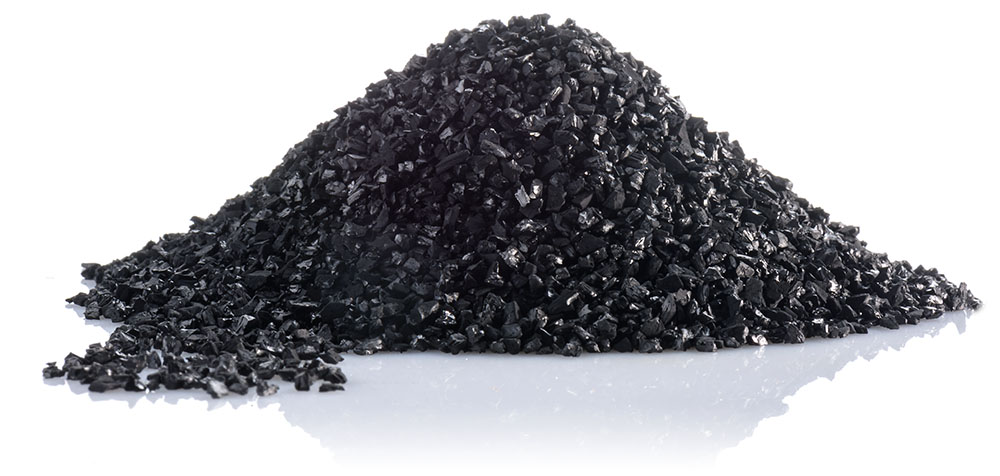
Typical Specifications of Medium Activity Carbons
| Test | Value | Standard |
|---|---|---|
| CTC | 50-60% | ASTM |
| IODINE | 1050-1100 mg/g | ASTM |
| BD | 0.48-0.49 g/cc | ASTM |
| MB | 168-180 ml/g | JIS |
| BENZENE | 32/33% | JIS |
| pH | 9-10 | ASTM |
| ASH | 3-4% | ASTM |
| MOISTURE | 3-4% | ASTM |
Size range available (US mesh)
| Size | Application |
|---|---|
| 80 X 30 / 12 X 30 | For weather purification, decolonization/ color and order removal |
| 6 X 16 / 8 X 30 / 12 X 40 | Industrial Water treatment |
| 4 X 8 / 6 X 12 | Air purification |
| 6 X 16 / 8 X 16 | Precious metal recovery |
| 4 X 8 / 6 X 12 | Aquariums |
| 30 X 100 | Filter block manufacture / Pet food additive (after powering) |
Special Carbons
- Catalytic Activated Carbon
- Silver impregnated Carbons
- Special chemical impregnated Carbons
- Acid washed /water washed /low silica carbons
Liquide Phase Applications
Beverage, wine, food, medical treatment, chemical industry, activated carbon has various functions in industrial production and it is widely used for decolorization.
| Industry | Description | Typical Use |
|---|---|---|
| Municipal Potable water preparation | Granular activated carbons(GAC) and powdered activated carbons(PAC) | Removal of dissolved organic contaminants, control of waste and odor problems, removal of residual chlorine and Disinfectant By Products (DBP) |
| Soft drinks | Potable water treatment, sterilization with chlorine | Chlorine removal and adsorption of dissolved organic contaminants |
| Brewing | Potable water treatment | Removal of Teihalomethanes (THM) and phenolics |
| Semi-Conductors | Ultra high purity water | Total organic carbon (TOC) reduction |
| Gold recovery | Operation of carbon in leach(CIL) and Carbon in pulp(CIP) and heap leach circuits | Recovery of Gold form ore, Gold from “tailings” dissolved in sodium cyanide |
| Petrochemical | Recycling of steam condensation for boiler feed water | Removal of oil and hydrocarbon cyanide |
| Ground water | Industrial contamination of ground water reserves | Reduction of total organic halogens (TOX) and absorbable organic halogens (AOX) including chloroform , tetrachlorethylene and trichloroethane |
| Process effluent | Industrial waste water treatment to meet environmental legislation | Reduction of total organic carbon (TOC), biological (BOD) and chemical oxygen demand (COD) |
| Swimming Pools | Ozone injection for removal of organic pollutants | Removal of residual ozone and control of chloramines |
Gas Phase Applications
Activated carbons are mainly used in the refinement of carbonate gas for beverages, in the industrial preparation of helium gas for natural gas, in ozone decomposition, in the separation of carbon dioxide in flue gas, etc.
| Industry | Description | Typical Use |
|---|---|---|
| Solvent recovery | Recovery of organic solvents to optimize process economics and control vapor emissions | Acetate fibers(acetone), pharmaceuticals (methylene chloride), film coating and printing (ethyl acetate), magnetic tape(MEK) |
| Carbon dioxide | Purification of carbon dioxide from the fermentation process | Adsorption of alcohols, amines, and mercaptans |
| Industrial Respirators | Adsorption of organic vapors | To meet CEN 141 standards – Type A respirators |
| Waste disposal | Disposal of domestic, chemical,l and clinical waste by high-temperature incineration | Removal of heavy metals and dioxins from flue gas |
| Cigarettes | Incorporation as either powder or granule in filter tips | Extraction of some harmful elements of cigarette smoke, or taste and flavor control |
| Air Conditioning | Heating, ventilation, and air conditioning (HEVAC) | Airports (partially combusted fuel odors ), offices(motor vehicle odors ), fume cupboards (solvent odors) |
| Composite Fibers | Impregnation of powder activated carbon into foam/fiber/non-woven substances | Air treatments, face masks and respirators,shoe insole deodorizers, and water treatments |
| Fridge deodorizers | In-situ filter units | Removal of general food odor |